The real state of llms.txt adoption in 2026
July 29, 2026
There is a version of this post that would be easier to write. It would open with a chart showing llms.txt adoption climbing, quote a couple of encouraging statements, and land on “get ahead of the curve.” We sell a plugin that generates these files, so that post would be in our interest.
The problem is that the data does not support it, and you can find the data in about ten minutes. So here is the version that holds up: what the evidence actually shows in 2026, what remains genuinely true in favor of publishing one, and how to decide whether you are in the group that should bother.
This post assumes you know roughly what the file is. If you do not, start with What is llms.txt? and come back.
The headline finding: publication is up, reading is not
Two numbers tell most of the story.
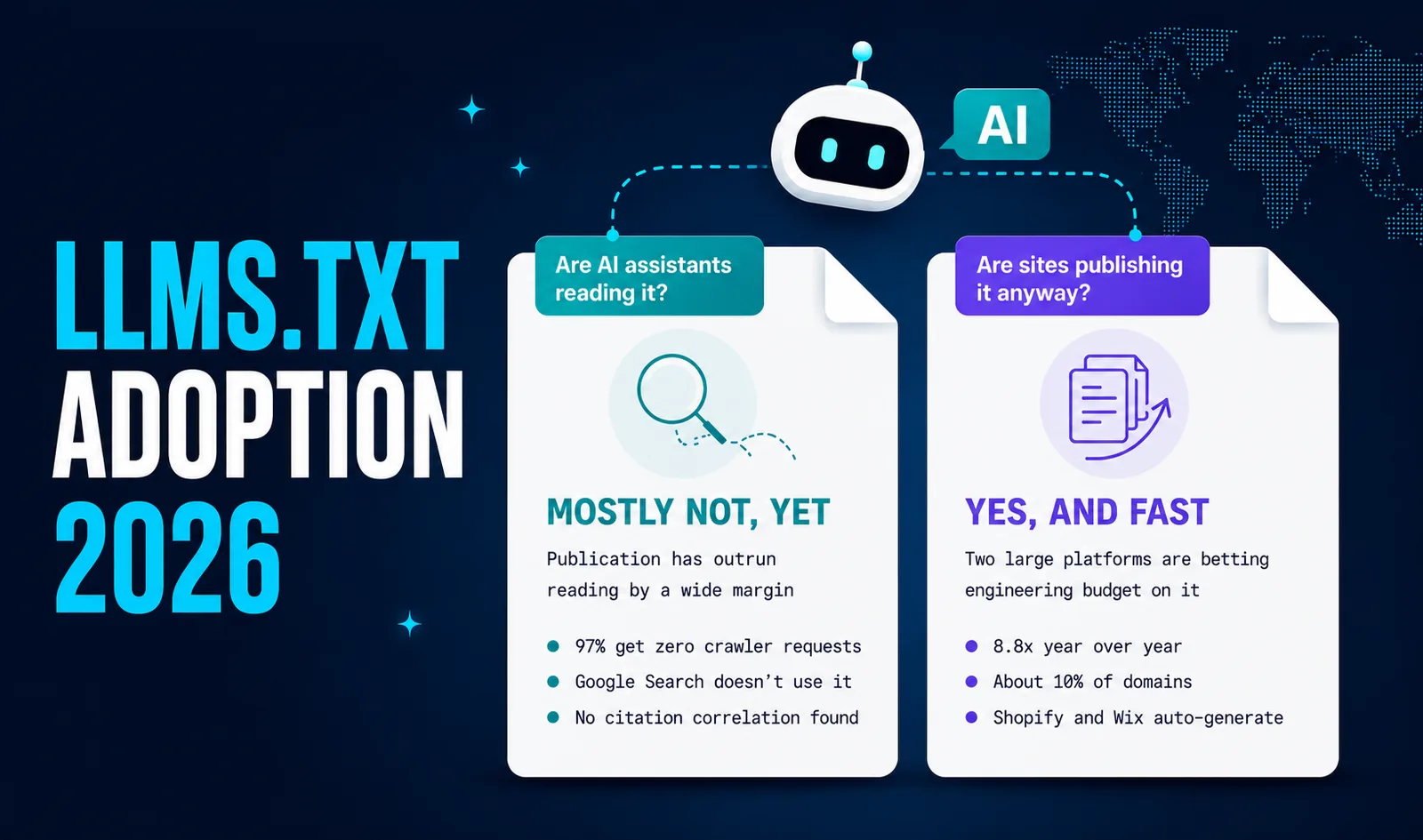
Publication is growing quickly. An Ahrefs study of roughly 137,000 domains, published in June 2026, found llms.txt adoption had risen 8.8 times year over year. A separate SE Ranking analysis of 300,000 domains put adoption at about 10%. Whatever your sampling method, a meaningful and growing slice of the web now publishes one.
Reading has not followed. In the same Ahrefs server-log data, 97% of llms.txt files received zero requests from AI crawlers during the study month. Of the requests that did arrive, AI retrieval bots accounted for around 1.1%. The bulk came from SEO audit tools at roughly 22%, unidentified bots at about 15%, and general web crawlers at about 13%. In other words, the thing most likely to fetch your llms.txt today is somebody’s SEO scanner.
A separate analysis reached the same conclusion from a different angle: across more than 500 million AI bot visits monitored over a 90-day window, only around 400 targeted an llms.txt file directly. GPTBot, ClaudeBot, PerplexityBot, and Google-Extended overwhelmingly fetch HTML instead.
The gap between those two numbers is the whole story. Publishing has outrun reading by a wide margin, and that is the honest state of things in 2026.
What Google has said, on the record
Google has been unusually direct about this, which removes any need to speculate.
Google’s AI optimization guidance, updated on May 15, 2026, tells site owners: “You don’t need to create new machine readable files, AI text files, markup, or Markdown to appear in Google Search (including its generative AI capabilities), as Google Search itself doesn’t use them.”
That covers AI Overviews and AI Mode as well as classic results, because those features draw from the same Search index. John Mueller of Google compared llms.txt to the old keywords meta tag: a file that bots do not request and services do not use. When asked in May 2026 why some Google developer properties publish one anyway, he explained that an internal content system had added support and some teams simply had not removed it, not that Search consumes it.
If your goal is Google visibility, in any of its forms, this file does nothing for you. Any copy suggesting otherwise, including any copy from us, would be wrong. The files that do serve search engines are your sitemap and your robots.txt, and those are separate jobs entirely.
Does it affect AI citations?
This is the question most people are really asking, and the answer available today is no measurable effect.
The SE Ranking work across 300,000 domains looked specifically at whether publishing an llms.txt correlated with how often a domain gets cited by large language models. Both statistical analysis and machine learning found no relationship. Having the file did not make a domain more likely to be cited.
That is not proof it can never help. It is a finding about the current state of a young convention, and correlational studies have limits. But it is the best evidence anyone has, and it points one direction: if you are publishing an llms.txt specifically to get cited more often by ChatGPT, Claude, Perplexity, Gemini, and other AI assistants, you are buying something the evidence does not currently support.
Where it is genuinely used
Now the other side, which is real and gets flattened in the skeptical coverage.
Developer tooling reads it. The convention started in developer circles and works there. Documentation-heavy, API-first companies like Anthropic, Stripe, and Cloudflare publish one because their audience works inside AI coding assistants that fetch documentation, and a clean Markdown index is far more useful to those tools than a JavaScript-rendered docs site. If your product has developer docs, this is a present-tense benefit.
Ecommerce platforms have committed to it. This is the shift that changed the picture in 2026. Shopify added native storefront routes for /llms.txt and /agents.md, generated automatically for stores, as part of its agentic commerce push. Wix generates one automatically for eligible sites, alongside structured data and its site MCP server. Neither company did that on a whim. They did it because they expect AI shopping agents to browse and buy, and they want their merchants readable when it happens.
That is a different kind of signal than a crawler statistic. It is two large platforms making a bet with engineering budget behind it.
Agents that act on a site benefit from it. When an AI tool needs to answer “which of these has the longest battery life?” or complete a purchase on someone’s behalf, it has to understand your catalog first. Parsing rendered HTML is slow, lossy, and easy to get wrong. A clean file is the cheaper path. This use case is early, but it is the one the platform investments are aimed at.
Where it is not used
To be equally clear about the boundaries:
- Google Search does not use it. Stated plainly, repeatedly, in official guidance.
- No major AI company has publicly committed to consuming it as a ranking or citation signal in production.
- Most
llms.txtfiles are never fetched by anything. 97% saw zero requests in the study month. - Reports that specific consumer assistants read it should be treated as unconfirmed signals rather than guarantees. Behavior changes and none of it is contractual.
So who should publish one?
The useful question is not “does llms.txt work,” it is “does the cost justify the option value for my site.” Cost is the deciding variable, because the benefits are speculative but small effort makes them worth having anyway.
Publish one if you run an online store. Your platform competitors on Shopify and Wix already ship one automatically. If agent-driven shopping grows even modestly, you want your catalog readable on the same terms as theirs rather than retrofitting under pressure. WordPress and WooCommerce do not generate one for you, which is the whole gap.
Publish one if you have developer documentation or an API. This is the case with a real, current audience. Your users are inside coding assistants right now.
Publish one if it is genuinely automatic. If a file generates and updates itself, the calculus is easy. A few minutes of setup buys you a clean machine-readable version of your site and a position on an emerging convention. That is cheap insurance in the plainest sense.
You can comfortably wait if your site is small and static, you have no store and no docs, and creating the file means writing and maintaining Markdown by hand. Hand-maintaining a file that almost nothing reads is a poor use of an afternoon, and a stale file describing your site inaccurately is worse than no file. Nothing bad happens to you for not having one.
The honest bull case
Strip out the hype and three arguments survive.
It is cheap insurance on a plausible trend. The direction of travel is more agents reading more sites more often. Whether llms.txt specifically is the format that wins is not settled, but the cost of being ready is close to zero when it is automated, and the cost of scrambling later is not.
It gives you editorial control over the machine-readable version of you. When a tool has to reconstruct your meaning from rendered HTML, the result is whatever it manages to salvage. When you publish the file yourself, you decide what is in it and how it reads. That is worth something independent of how many bots currently fetch it.
Platform behavior is a stronger signal than crawler logs. The 97% number describes today. Shopify and Wix shipping automatic generation describes what two large companies expect tomorrow. Both are true at once, and the second is the one that would change the first.
None of that adds up to “publish this and get found by AI.” It adds up to something more modest and more defensible: this is a low-cost, low-risk piece of hygiene with real upside if adoption broadens, and no downside if it does not.
The short version
Publication of llms.txt is up sharply. Reading is not: 97% of files got zero requests in the most thorough study available, Google says outright that Search does not use it, and no correlation with AI citations has been found across 300,000 domains. At the same time, developer tooling genuinely reads it, and Shopify and Wix now generate one automatically for stores, which is a real bet by real platforms.
Publish one if it costs you almost nothing, especially if you run a store or ship documentation. Do not publish one expecting rankings or citations. Anyone promising those is ahead of the facts.
Project LLMs.txt generates and updates your llms.txt and llms-full.txt from your existing WordPress content, WooCommerce included, so the cost side of this decision stays near zero. It is free to install.
Sources: Ahrefs, “We Analyzed 137K Sites: 97% of llms.txt Files Never Get Read”; SE Ranking, “LLMs.txt: Why Brands Rely On It and Why It Doesn’t Work”; Search Engine Journal on Google’s position; Wix on agentic commerce.